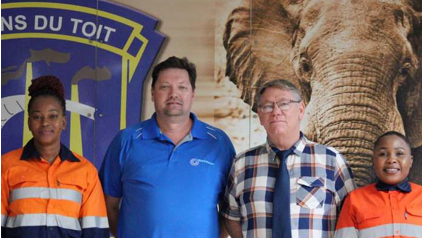
In a joint effort to advance education and digital skills development in Phalaborwa, Palabora Mining Company (PMC) and LH Marthinusen (LHM) have partnered to establish a fully equipped robotics and coding classroom at Frans du Toit High School. This initiative forms part of a broader socio-economic development commitment by both organisations to uplift the local community through education-focused corporate social investment.
While LHM was recently awarded a major contract to design, supply, install, and commission main surface ventilation fans for PMC, this partnership extends beyond infrastructure — it reflects a shared vision for sustainable community development. As part of the agreement, LHM has committed over R500 000 to support the school’s drive to modernise its curriculum and equip learners with critical skills for the digital economy.
The project includes the establishment of two computer laboratories, installation of 20 and upgraded 12 desktop computers, a 3D printer, and a central server, as well as the provision of a licensing package, textbooks for Grade 8 and 9 learners, and training for four teachers. The new classrooms were completed and fully operational in time for the first school term in 2025.
“Frans du Toit High School needed support to stay relevant in a fast-evolving academic environment,” said David Sullivan, Divisional CEO at LHM. “By investing in this initiative, we’re helping build a future pipeline of digitally literate talent.”
School Principal Mr Johann Janse van Rensburg noted the importance of the intervention: “We recognised the need to align with future education trends and the Department of Primary Education’s development goals. This project enables us to do just that.”
LHM and PMC’s collaboration exemplifies how business partnerships can contribute meaningfully to local development — not only through industrial capability but by investing in the people and potential of the communities they operate in.