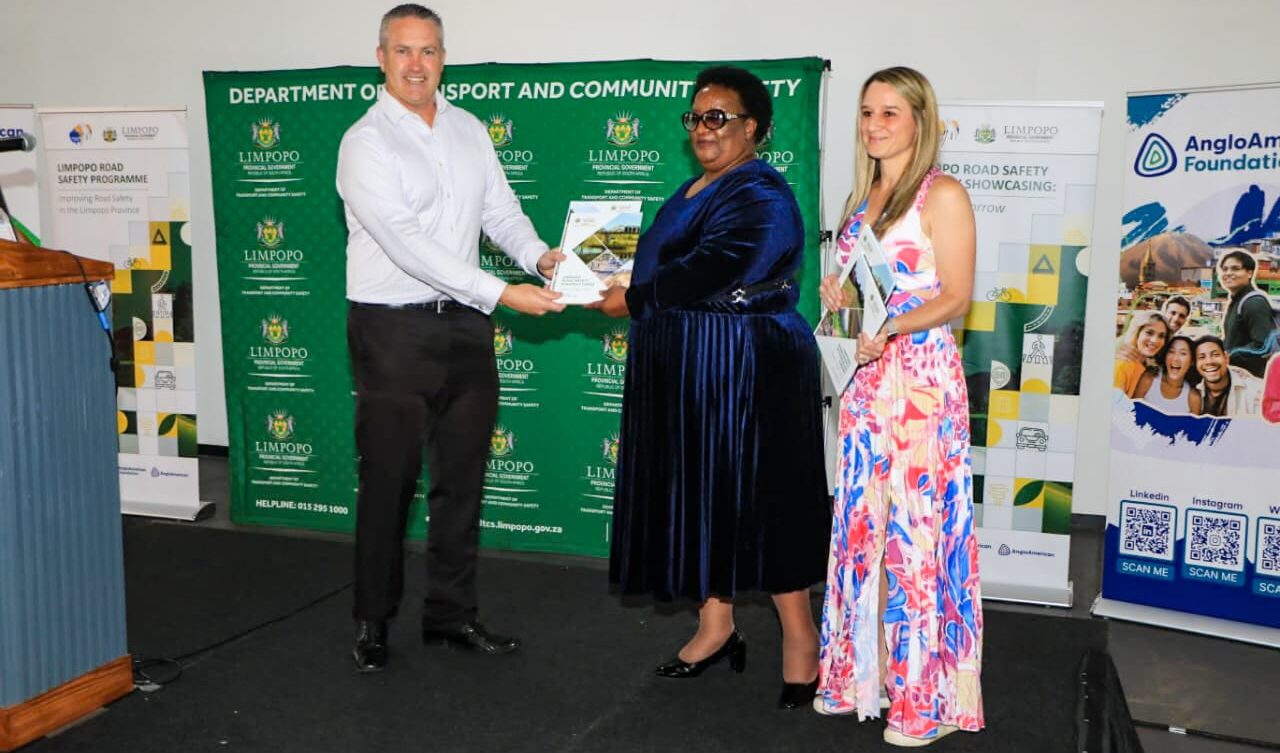
Limpopo has taken a major step toward safer roads, as the Office of the Premier and the Department of Transport and Community Safety officially assumed full custodianship of the Limpopo Road Safety Programme (LRSP).
The Custodianship 2026 event, recently held in Polokwane, celebrated the collective achievements of the initiative and marked the start of its next chapter, a five-year strategy running from 2026 to 2030 aimed at cutting road deaths and serious injuries by half by 2030.
Funded by The Anglo American Foundation and implemented in partnership with the Impact Catalyst, the LRSP has become a leading example of how government, business, and communities can work together to save lives and build safer transport systems across the province.
“Our participation in this programme was guided by the noble endeavour of forming continuous partnerships that are at the centre of this Government’s developmental agenda,” says MEC Ms. Violet Mathye, Limpopo MEC for the Department of Transport and Community Safety. “We view this partnership and many others as a fundamental step towards building a society that we have always envisioned.”
Ambitious targets driven by data
The next phase of the programme builds on years of evidence-based planning and measurable impact. At its core is a bold commitment to the United Nations Decade of Action for Road Safety 2021–2030 and the goal of halving road fatalities in the province.
One of the priority projects included are the International Road Assessment Programme (iRAP) surveys, which scientifically assess road safety design and risks for all users. Over 1,500 kilometres of Limpopo’s high-risk roads were analysed, and the results were clear: a significant number of roads were rated below a 3-star safety level for vehicle occupants.
This data now drives all provincial planning, ensuring that infrastructure upgrades, signage improvements, and enforcement measures are focused where they will save the most lives.
“This data allows us to target our interventions where they matter most,” says Dr Jonathan James, Programme Manager at the Impact Catalyst. “By integrating data from multiple departments, the Province can act with greater transparency, accountability, and precision.”
Turning strategy into life-saving action
The LRSP’s success is visible across all pillars of the Safe System Approach, delivering practical, life-saving results:
- Stronger emergency response: Over 1,100 Emergency Care Officers (ECOs) have been trained in the latest standardised clinical practices, transforming pre-hospital emergency care across the province.
- Safer learners, safer drivers: The VIA school safety programme has reached more than 3,000 learners in 22 schools, while the Youth Drivers’ Project has helped 112 learners earn their learner’s licences and 26 become licensed drivers, with 86 more on track to complete by January 2026.
- Institutional strengthening: 89 provincial officials have received formal training in the Safe System Approach, building long-term capacity for evidence-led road safety management.
A model built for collaboration and scale
The LRSP has been delivered through close collaboration with provincial departments including Transport and Community Safety, Health, Education, Public Works, and Social Development, alongside technical partners such as the CSIR, the University of Johannesburg, and municipalities including Musina and Blouberg.
“Our work goes beyond strategies and data,” says Dr Mari Romijn, Head of Capable State at the Impact Catalyst. “We’re building the systems, skills, and partnerships that make safer roads everyone’s responsibility. When communities, learners, and officials work together, real change happens.”
With custodianship now transferred to the Department of Transport and Community Safety, the Province is ready to scale and sustain its results — setting a new, people-focused benchmark for road safety in South Africa.
“The success here shows that when strategy, data, skills, and community engagement come together, measurable outcomes follow,” adds Dr James. “This programme is more than a project — it’s a blueprint for lasting change.”
“As we receive the Limpopo Road Safety Strategy and Action Plan, we are also committing that it will be fully implemented, like the many others that we have optimally executed in previous occasions,” says MEC Mathye. “This is the only way through which we can fully attain a road fatality-free society, and we must elevate this partnership to other platforms across the province so that its impact is felt far and wide.”