South Africa’s Minister of Higher Education issued a warning in September 2025 that partnerships must not undermine national sovereignty in artificial intelligence. The same week, Nigeria accepted $3.5 million from Microsoft, Google and Meta to build indigenous language models. This apparent contradiction — asserting independence whilst accepting foreign support — reveals Africa’s distinctive approach to AI sovereignty.

The concept puzzles observers accustomed to binary thinking about technological independence. Europe regulates. China controls. America innovates. Africa, conventional wisdom suggests, merely consumes. Yet recent policy initiatives across the continent demonstrate something more sophisticated: pragmatic sovereignty that acknowledges interdependence whilst maintaining strategic autonomy.
This approach emerges from hard-won experience. Post-colonial nations learned that political independence without economic capacity perpetuates dependency through subtler means. Complete self-sufficiency proves impossible in interconnected systems. Uncritical adoption of foreign technology creates new forms of subjugation. Africa’s AI strategies navigate between these extremes.
Building Foundations, Not Just Rules
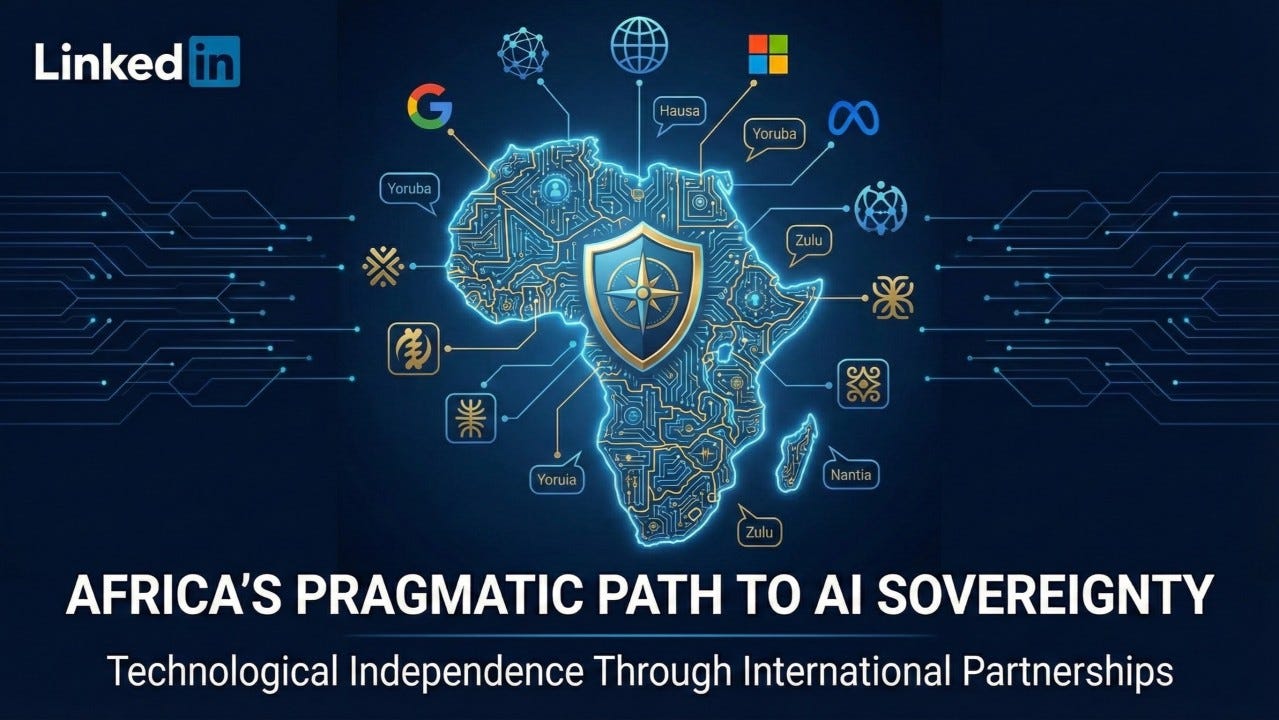
Nigeria’s language model initiative exemplifies infrastructural sovereignty. Rather than merely regulating how foreign AI systems operate domestically, Nigeria builds foundational models that understand Hausa, Yoruba and Igbo. This matters profoundly. Whoever controls foundational models shapes how AI systems understand reality — whose knowledge counts, which concepts matter, what problems deserve solving.
Current AI systems encode Silicon Valley’s assumptions as universal truths. They recognise English idioms but not African proverbs. They understand Western business practices but not rotating savings clubs. They optimise for individual achievement rather than communal harmony. Translation layers cannot fix this fundamental bias. Only indigenous models can encode African ways of knowing.
South Africa pursues institutional sovereignty through different means. Its Centre for Artificial Intelligence Research coordinates expertise across universities, building domestic capacity for both development and governance. Parliament declared existing laws “not fit for purpose” and committed to new AI legislation. The approach prioritises long-term capability over short-term access.
Even Burkina Faso, ranking among the world’s poorest nations, explicitly prioritises local talent over foreign expertise in developing its AI roadmap. The preference seems quixotic given resource constraints. Yet it reflects sovereignty consciousness that transcends material capacity. Nations that outsource thinking about their technological future forfeit their ability to shape it.
The Partnership Paradox
African nations’ international partnerships appear to contradict sovereignty assertions. How can you claim independence whilst depending on foreign funding and expertise? The question misunderstands sovereignty’s evolution in interconnected systems.
Smart Africa’s Continental AI Council, established in September 2025, reveals the model. Six thematic working groups enable international participation whilst maintaining African institutional control. The structure acknowledges that isolation guarantees irrelevance in global AI development. Yet it ensures African priorities shape engagement terms.
Director General Lacina Koné frames this as achieving “digital sovereignty in the global AI race” — not digital sovereignty through withdrawal from it. The distinction matters. Sovereignty no longer means autarky but rather the capacity to engage on chosen terms.
African nations cannot match Silicon Valley’s resources or Beijing’s coordination. They can define their participation conditions. Consider Malawi’s climate AI partnership with Dubai. Malawi lacks capacity to build sophisticated climate monitoring systems independently. Yet it maintains sovereignty by defining the application — climate adaptation — controlling implementation, and owning the resulting insights. Sectoral sovereignty — controlling specific domains rather than entire technology stacks — proves more achievable than comprehensive independence.
Historical Echoes, Digital Futures
Post-colonial experience profoundly shapes African AI strategies. Colonial powers imposed languages, laws, and economic structures that persist decades after independence. Contemporary AI systems risk digital colonialism — imposing foreign concepts, extracting data value, and perpetuating technological dependency.
Yet African approaches reflect agency, not victimhood. The continent’s AI strategies demonstrate learning from historical experience. Complete autonomy proved impossible after political independence: economic interdependence remained necessary. The same holds for technological sovereignty. The question becomes how to engage without surrendering control.
African digital sovereignty emphasises different concerns than other models. Where Europe focuses on regulatory authority and China on state coordination, Africa prioritises cultural preservation, linguistic diversity, and development applications. The G20’s attention to AI’s cultural implications under South African presidency revealed these distinctive priorities. Technology should serve development, not development serve technology.
This orientation challenges assumptions about AI governance requiring either comprehensive state control or unfettered market dynamics. African nations demonstrate a third path: selective engagement that preserves strategic autonomy whilst accessing necessary resources.
Tensions and Trade-offs
Pragmatic sovereignty creates genuine tensions. Technology corporations providing funding influence development priorities. Technical assistance creates expertise dependencies. International standards may conflict with local values. These tensions lack clean resolution.
Nigeria’s language model funding illustrates the challenge. Microsoft, Google and Meta provide essential resources but bring their own agendas. Will models reflect Nigerian priorities or corporate interests? Can indigenous innovation emerge from foreign-funded projects? Time will tell whether pragmatic partnerships enable genuine sovereignty or merely sophisticate dependency.
Capacity building takes time that technological change may not allow. While African institutions develop expertise, global AI systems entrench themselves. Network effects and data advantages compound early leaders’ dominance. African nations race against technological lock-in that could permanently marginalise their contributions.
Resource allocation forces uncomfortable prioritisation. Nigeria’s focus on major languages marginalises hundreds of smaller ones. South Africa’s urban-centred AI development may deepen rural exclusion. Continental coordination remains aspirational whilst national interests diverge. Sovereignty for whom becomes as important as sovereignty from whom.
Beyond Binary Choices
Africa’s AI sovereignty approach offers lessons for all nations navigating technological interdependence. Pure independence proves impossible in networked systems. Complete dependence sacrifices agency. Most nations must chart middle courses.
The pragmatic sovereignty model acknowledges that engaging global technology systems requires compromise. The alternative — principled isolation — guarantees irrelevance. Yet engagement need not mean capitulation. Nations can assert sovereignty through strategic choices about where, how, and on what terms to participate.
Small nations particularly benefit from Africa’s example. They cannot replicate great powers’ comprehensive technology strategies. But they can achieve sectoral excellence, build specific capabilities, and shape particular domains. Sovereignty becomes granular rather than absolute.
The approach also challenges development orthodoxy that positions Global South nations as technology recipients rather than creators. African AI initiatives demonstrate indigenous innovation addressing local priorities. Solutions emerge from constraints. Necessity drives creativity that abundance often stifles.
Writing Tomorrow’s Code
African digital sovereignty in AI remains aspirational. Technical challenges persist. Funding uncertainties loom. Political commitment wavers. Success is not guaranteed.
Yet the attempt reshapes global AI governance discourse. By asserting that sovereignty requires controlling foundational technologies, not just regulating their use, African nations expand governance imagination. By demonstrating that cultural and linguistic concerns deserve equal weight with economic and security priorities, they broaden AI ethics. By pursuing pragmatic partnerships whilst maintaining strategic autonomy, they model sovereignty for an interdependent world.
The ultimate test lies ahead. Can African nations translate sovereignty aspirations into sustained technological capability? Will pragmatic partnerships enable genuine independence or sophisticated dependency? Can post-colonial insights generate post-digital innovations?
These questions matter beyond Africa. As AI systems increasingly mediate human activity, their design assumptions shape global futures. If those assumptions reflect only dominant powers’ perspectives, humanity loses cognitive diversity essential for addressing complex challenges. African sovereignty in AI — however partial, pragmatic, or precarious — preserves space for alternative approaches.
The stakes transcend technology. They concern whether globalisation means homogenisation or permits genuine pluralism. Whether development requires mimicry or allows indigenous innovation. Whether the future’s algorithms speak only power’s language or humanity’s full chorus.
Africa chooses sovereignty — not as isolation but as intentional engagement. Not as complete control but as strategic autonomy. Not as rejection of interdependence but as insistence on agency within it.
The continent that taught the world about political liberation from colonialism now explores technological liberation from digital imperialism. The lessons merit attention.
Can genuine technological sovereignty exist in interdependent systems? What would post-colonial insights contribute to global AI governance?