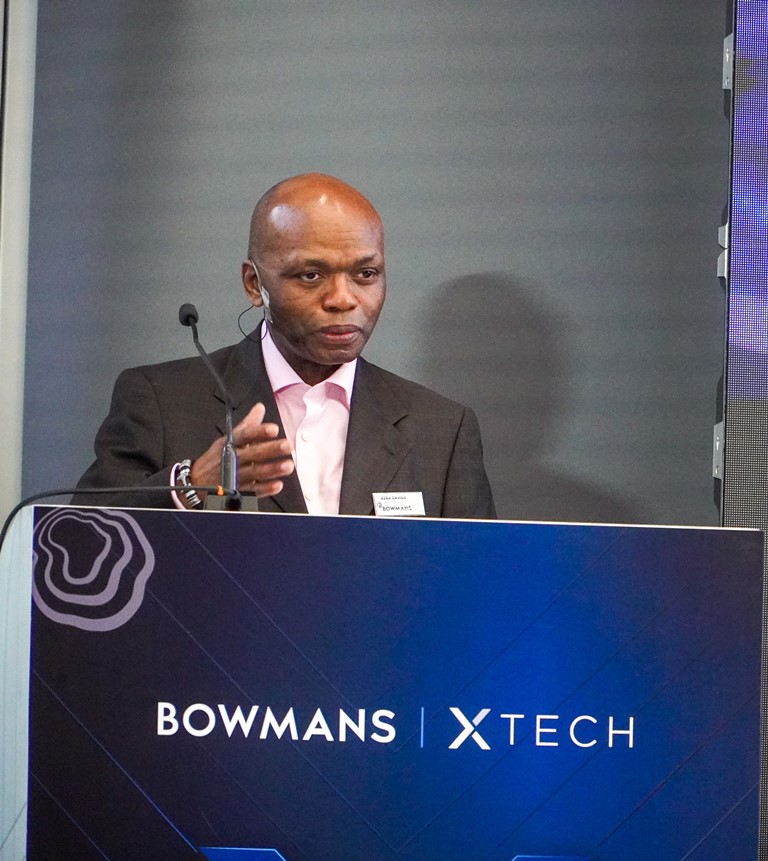
New firm-wide approach brings together legal, sector and market expertise to support businesses pursuing technology opportunities across Africa.
Leading technology and business executives gathered in Johannesburg for Bowmans X Tech Week, a programme exploring how technology is creating new opportunities for African businesses and what organisations need to turn those opportunities into commercial success.
The event also marked the launch of Bowmans X Tech, a firm-wide approach that brings together legal, sector and market expertise to support clients wherever technology affects their business.
Ezra Davids, Chairman and Senior Partner of Bowmans, noted that Africa is not simply participating in the global digital economy, but in many respects shaping it. “Across the continent, we are seeing bold innovation, growing investment and increasing digital adoption. Entrepreneurs are solving problems at scale. Established organisations are transforming the way they operate. Regulators are engaging with technologies that would have been unimaginable only a few years ago. The challenge before us is to create the conditions that allow innovation to flourish, scale and deliver lasting value.”
He added that technology-related opportunities and challenges no longer fit neatly into a single category. “A business considering an AI solution is likely thinking about governance, data, regulation, intellectual property, risk, investment and customer trust, all at once. This requires collaboration, constructive dialogue, and assembling the kind of expertise represented in this room today.”
Bowmans X Tech Week brings this approach to life by gathering business leaders, regulators, technologists, investors and legal specialists together to exchange perspectives on Africa’s technology opportunities and challenges. The programme includes discussions on digital infrastructure, artificial intelligence, investment, governance and the commercial considerations surrounding technology adoption, led by keynote presentations and panel discussions featuring experts from a range of both global and local companies in diverse sectors including the technology sector, as well as various regulators and legal and business leaders from across the continent.
In his opening keynote, Serame Taukobong, Group Chief Executive Officer of Telkom, identified three responsibilities for business leaders shaping Africa’s digital future. “As technology becomes more powerful, we must ensure more people have the power to build, create value, earn trust, and enable scale. Too often, investments in technology infrastructure duplicate in the same metros and suburbs while other communities continue to wait.”
He challenged business leaders to look beyond pure investment in technology and ensure that investment converts into opportunity, revenue and outcomes at the speed the economy needs. “Every person in the room has the opportunity and capability to remove one barrier, whether that is stalled approvals or unresolved clauses. If we grab this opportunity, we can achieve the ambition of making African capability as available to the world as African demand.”
The practical implications of AI adoption featured in the programme with the launch of Vodacom’s group-wide AI policy. Ayman Essam, Chief External Affairs Officer at the Vodacom Group, called for a principles-based framework for responsible regulation of AI in Africa. “Telecommunications companies play a unique role in customers’ lives. We are there for every major moment, good and bad. That makes it critical that we carefully consider how our customers can get the best out of AI while still being protected from potential harms.”
As people increasingly depend on AI as a primary source of information, new risks are emerging. “Customers could receive incorrect healthcare advice from their AI tools, or have their bank account blocked due to an AI-driven process. As we face the wave of AI innovation, it’s easy to simply go along and be carried away by the wave. But we need to take pause and ensure we are catalysts for the responsible use of AI, both within our business and within the lives of our customers.”
Lele Modise, Group Chief Legal and Regulatory Officer at MTN, said Africa’s next technology challenge is not simply connectivity, but creating the conditions for innovation to thrive and scale. “African innovation can solve real problems and reach platforms that scale across markets. The question is not whether Africa participates in its digital future, but whether the continent shapes that future itself, or simply adapts to choices made elsewhere.”
She added that the answer is not to reject global providers or retreat from global markets. “Africa does not need to build everything on its own. But we must ensure that we create the capacity, capabilities and regulatory environment for Africa to gain greater agency over the technologies shaping its social and economic future.”
In his closing remarks, Standard Bank Group CEO Sim Tshabalala noted that Africa’s digital gap was not a consequence of a lack of public sector investment. “Yes, there is a real digital gap. The continent is home to 18% of the global population, but less than 1% of data centre capacity. But, importantly, building out data centres across the continent does not need public sector or development finance – people are clearly willing to pay for the services they enable. Given regulatory certainty and the rule of law, the necessary private investment will flow.”
He lauded the legal system as an enabler of economic growth. “Legal systems are among the greatest technologies ever devised. They generate sufficient trust and certainty to enable credible commitments to future actions, and allow strangers to trust one another.”