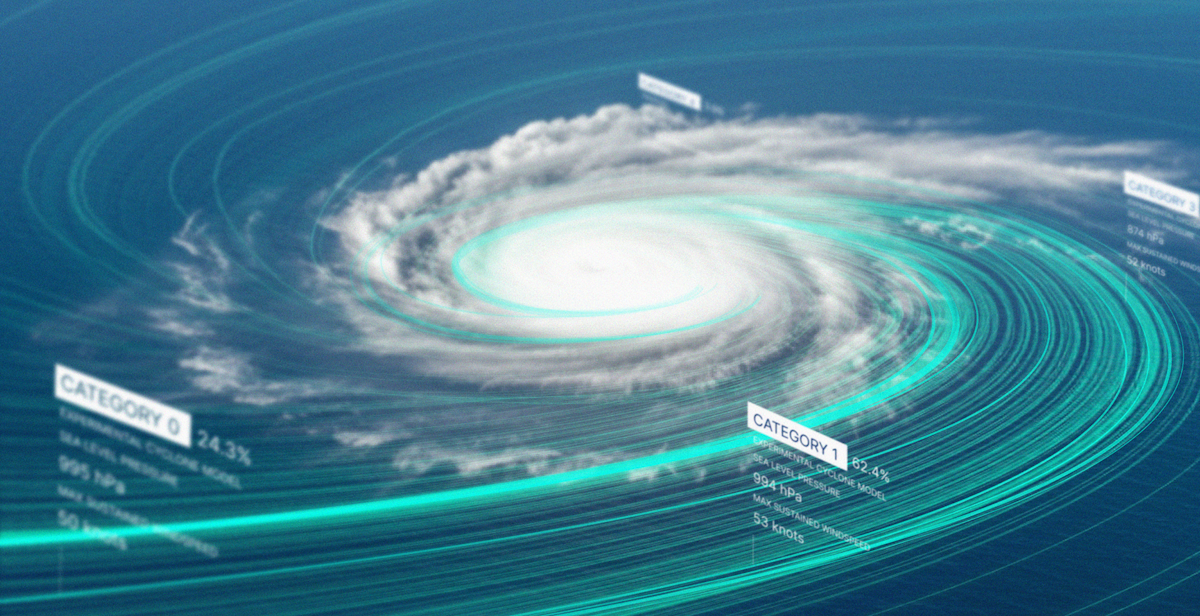
Today Google DeepMind and Google Research announced its latest work supporting better cyclone predictions with AI – including a new experimental model, an interactive website for visualising our AI weather models, and a partnership with the U.S. National Hurricane Centre this hurricane season.
-
Tropical cyclones, also known as hurricanes and typhoons, are among the most dangerous weather events. In the last 50 years, they’ve claimed hundreds of thousands of lives and caused $1.4 trillion in economic losses.
-
Cyclones are very sensitive to even small differences in atmospheric conditions – and data is sparse – making them notoriously difficult to forecast accurately. But improving forecasts can have a huge impact on protecting communities.
-
Experimental model: Our experimental cyclone model addresses key challenges in cyclone prediction. It can skillfully predict a cyclone’s formation, track, intensity, and size – generating up to 50 possible scenarios, up to 15 days ahead.
-
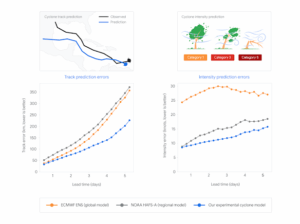
According to our internal evaluations and evaluations from the Cooperative Institute for Research in the Atmosphere (CIRA), our model shows comparable or greater skill than the best operational physics-based models for cyclone track and intensity.
-
Interactive website: We’re launching a public preview of a new interactive website called Weather Lab. It will show live and historical cyclone predictions from different AI weather models (our experimental cyclone model, WeatherNext Graph, WeatherNext Gen), alongside physics-based models from the European Centre for Medium-Range Weather Forecasts (ECMWF).
-
NHC partnership: We’ve been partnering with the U.S. National Hurricane Center (NHC), who assess cyclone risks in the Atlantic and East Pacific basins, to scientifically validate our approach and outputs. Their expert forecasters are now seeing live predictions from our experimental AI models, alongside other physics-based models and observations. We have also been collaborating with CIRA, the UK Met Office, the University of Tokyo, Japan’s Weathernews Inc. and other experts to improve our models.
Further details can be found in our blog here. And you can explore the Weather Lab here.