People thought AI was going to take away our critical thinking skills. But as AI takes on more execution, new research shows workers are gaining more control over decision-making, creativity, and outcomes. The problem: most organisations aren’t built to take advantage of it.
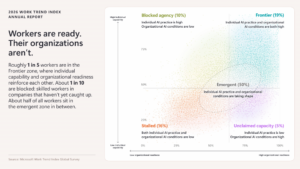
Microsoft’s 2026 Work Trend Index, based on trillions of anonymised Microsoft 365 productivity signals and a survey of 20,000 workers across 10 countries, reveals a widening gap between what workers can now do with AI, and what their organisations are structured to support.
Why this matters now
- AI adoption is accelerating, but its impact isn’t determined by individual skill alone.
- Organisational design, not talent, has become the bottleneck.
- Frontier Firms that rethink how work is structured are already pulling ahead.
Key research findings
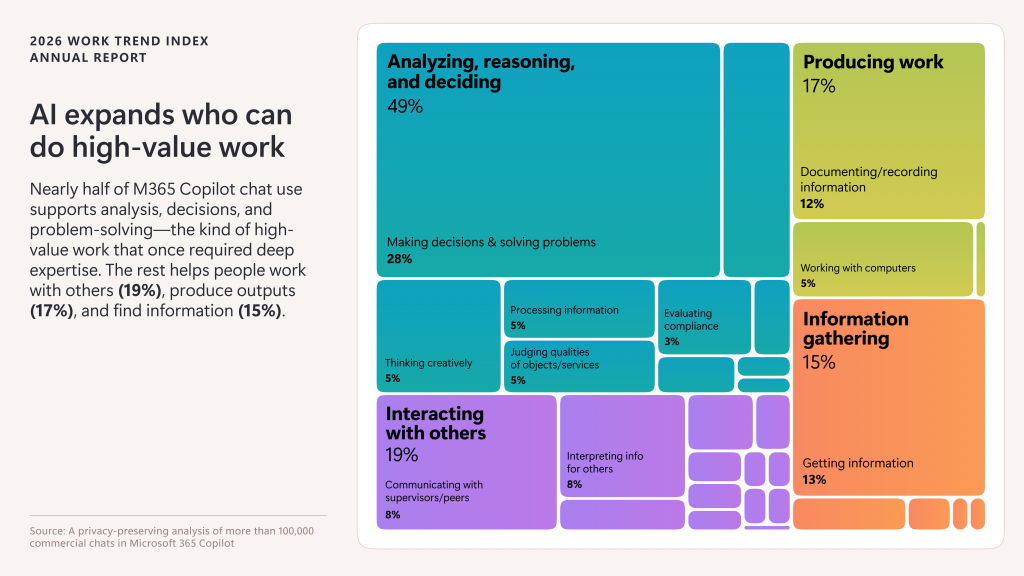
- AI lifts individual potential. A privacy-preserving analysis of more than 100,000 chats in Microsoft 365 Copilot shows that 49% of all conversations indicate cognitive work – analysing information, solving problems, evaluating, and thinking creatively – expanding how AI helps individuals do high-value work. That shift is already visible in output, with 58% of AI users in our survey say they’re producing work they couldn’t have a year ago, rising to 80% among Frontier Professionals.
- Human agency is the new competitive advantage. When AI users were asked which human skills are most important as AI takes on more work, they said two topped the list: quality control of AI output (50%) and critical thinking – that is, analysing information objectively and making a reasoned judgment (46%).
- #1 driver of AI impact isn’t individual – it’s institutional. Organisational factors – culture, manager support, talent practices – account for more than 2X the AI impact of individual factors like mindset and behaviour (67% vs. 32%). This means the defining question is not whether individuals have the skills, but whether the organisation has built the culture, management practices, and talent systems that incentivise and support new ways of working.
- Watch out for the Transformation Paradox. A pressure point is emerging where the pull to perform collides with the push to transform. 65% of AI users fear falling behind if they don’t adopt AI fast, yet 45% say it feels safer to stick to current goals than redesign work. Only 13% feel rewarded for reinvention. The same forces speeding adoption also slow it.
- Every organisation is a learning system. Agents in the Microsoft 365 ecosystem have increased 15x year over year and 18x in large enterprises. Frontier Firms pulling ahead aren’t just adopting AI, they’re redesigning how work gets done. Their work produces output and insights that gets captured, shared, and built into how the organisation operates. They function as a learning system.