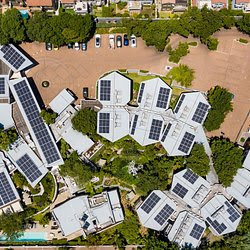
Five installations delivered safely on schedule and within budget across a live, six-hotel portfolio, with phase 2 carport solar and battery energy storage now in construction at three sites for time-of-use tariff arbitrage
South African solar EPC+M company Rhino Energy Solutions has completed five solar PV installations across the Capital Hotels & Apartments portfolio. This marks a key milestone in a multi-year rollout that began with a single pilot in 2022 and has since grown to span six hotels, a power purchase agreement (PPA) structure, and, at three sites, a battery energy storage system (BESS) pilot designed for time-of-use tariff arbitrage.
At a glance
- 6 hotels in the programme
- 5 installations completed to date – safely, on schedule and within budget
- 3 MWp solar PV installed
- 387 kWp on carport structures in construction at two sites
- 5 MWh BESS in construction at three sites
How the programme started
In February 2022, Capital Hotel Group visited Rhino Energy’s site at The Catalyst Hotel and raised the idea of taking a serious look at solar across the group’s hotel portfolio, with the operating-cost benefit as the primary driver. Rhino Energy Solutions assessed twelve hotels against three criteria: available roof space, tariff structure, and overall commercial benefit.
Capital Empire was identified as the pilot site for a grid-tied solar installation.
A PPA-funded, phased rollout
The commercial structure adopted was a PPA, delivered through a joint venture between Capital Hotels and Apartments and HyperionRE, Rhino Energy Holdings’ PPA entity. The JV owns the solar assets and sells the electricity generated back to each hotel, meaning the hotel receives the operational cost saving without capital outlay for the installation.
“We didn’t want a single flashy solar installation for the sake of a headline, we wanted a model that made sense across the portfolio,” says Jurie Bezuidenhout, Managing Director of The Capital Hotels & Apartments. “The PPA structure let us do that without diverting capital from other priorities, and the result we saw at Capital Empire gave us the confidence to keep expanding on our solar initiative with Rhino”
The Capital Empire pilot delivered annual tariff increases below NERSA’s benchmark since commissioning, which supported the case for a phased expansion:
Phase 1 added grid-tied solar at three further hotels: Capital Seven Villa and Spa, Capital Melrose and Capital Mbombela. Phase 2, from mid-2025, introduced a grid-tied system at Capital 15 on Orange in Cape Town, alongside carport solar and BESS installations now underway at Seven Villa, Mbombela and Zimbali.
Delivering solar across live, operating hotels
Installing solar across fully operational hotels presented a distinct combination of technical, logistical and operational challenges. The primary objective throughout was maintaining business continuity while keeping disruption to guests, staff and daily hotel operations to a minimum, alongside the safety demands of working at height on live buildings. Not every one of the original twelve hotels passed structural assessment or had sufficient roof space, which shaped the final site selection and sequencing of the rollout.
The project team addressed these constraints through detailed planning, proactive communication, close coordination with hotel management, and strict adherence to the agreed construction programme. The Capital Empire pilot provided valuable lessons that were carried into subsequent installations, particularly the importance of maintaining direct, consistent communication with each hotel’s General Manager, and establishing a dedicated daily WhatsApp communication group so that issues could be identified and addressed quickly.
“Working on a live hotel is a different discipline to a greenfield industrial rooftop,” says Rogan Davies, Group CEO at Rhino Energy Solutions. “Everything has to work around guests and operating hours, and the safety demands of working at height don’t get any lighter just because the client is hospitality rather than manufacturing. Not every roof in the portfolio was going to qualify, and being upfront about that early saved everyone problems later. Keeping a direct line open with each GM made it far easier to catch and solve issues before they became delays.”
Track record: five sites, on time and on budget
All five completed installations to date have been delivered safely on schedule and within budget. Returning to Capital Seven Villa and Spa recently for the carport solar expansion was a particularly rewarding milestone for the project team, offering a chance to see the original installation in full operation and reflect on the progress made across the portfolio since. The team attributes this consistency to strong planning, communication, teamwork and disciplined project execution across a multi-site rollout. The same disciplines now being applied to the BESS pilot at three of the six hotels.
The battery pilot: one job, tariff arbitrage
Three hotels: Capital Mbombela, Capital Seven Villa and Spa, and Zimbali have been identified for battery energy storage systems (BESS), currently in construction. Alongside carport structures that add further PV capacity where roof space is limited, the BESS installations are designed to do a single job: time-of-use tariff arbitrage. They charge from solar generation during the day and from off-peak grid supply overnight, then discharge during each hotel’s peak tariff periods in the early morning and evening.
The system has deliberately not been configured for backup power. Keeping the battery’s function singular, arbitrage only, is intended to make sizing and, later, performance measurement more straightforward: any saving recorded can be attributed cleanly to the arbitrage strategy rather than blended across multiple functions.
“On the battery side, keeping the system’s job simple, arbitrage only, nothing blended in, made the engineering more straightforward,” Davies adds, “and it’ll make it much easier to point to a clean, honest number once the sites are live.”
Early results
The three BESS sites are still in construction, so no verified saving figure is available yet.
“The battery pilot is the next test,” Bezuidenhout says. “If it delivers predictable savings against our peak tariff periods, it becomes part of how we think about every future hotel in the group.”