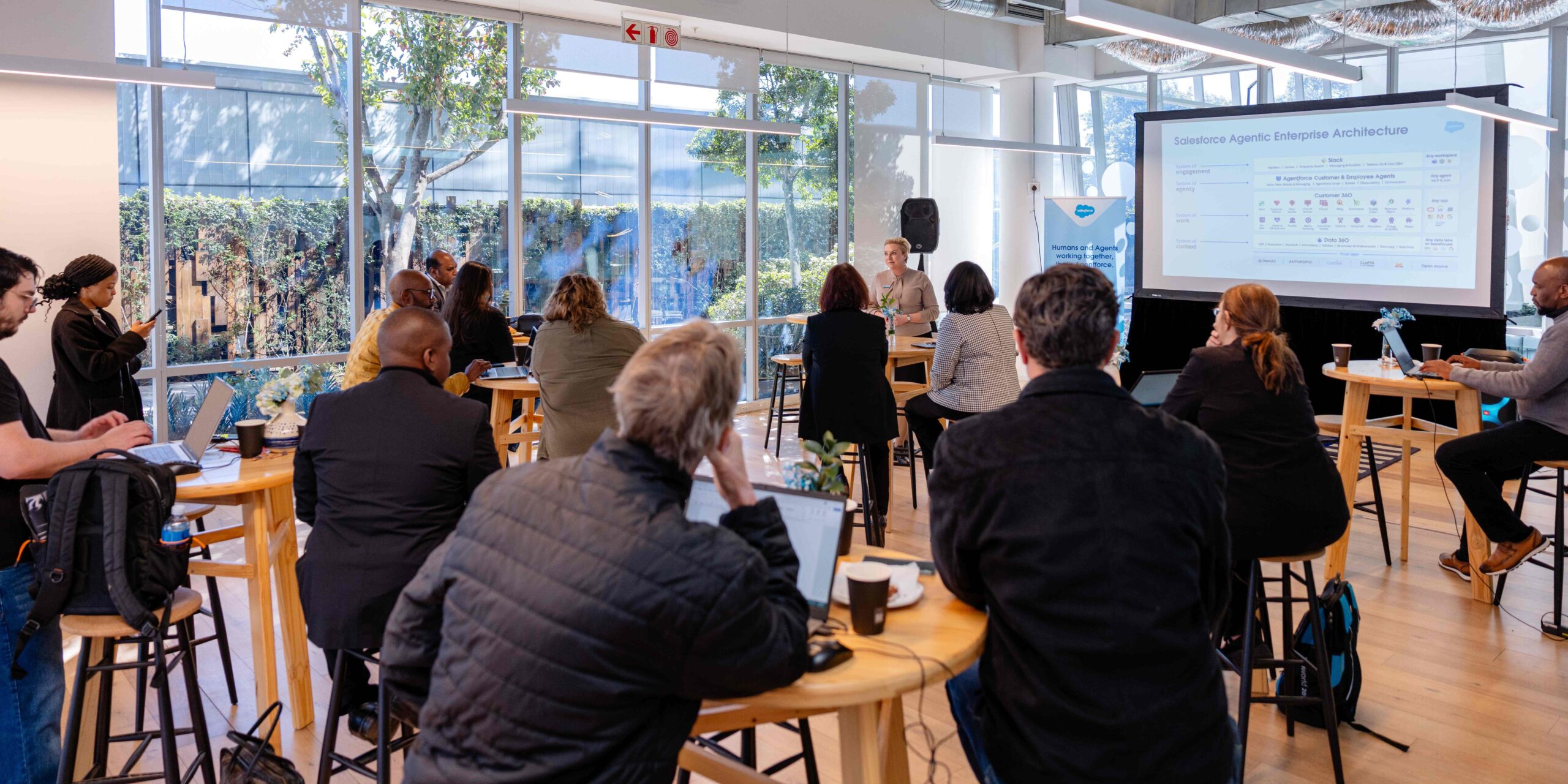
At an exclusive Johannesburg media roundtable, Salesforce leaders and Standard Bank Group’s change lead issue a frank warning: the window for cautious, incremental AI adoption has closed.
Salesforce hosted an intimate media roundtable at WeWork Oxford Road in Rosebank for a candid, unvarnished conversation about AI’s mounting impact on the South African workforce. Bringing together senior Salesforce leaders and an enterprise change practitioner from Standard Bank Group, the session produced a collective message that left little room for equivocation: AI is already reshaping how work is designed, delivered, and measured — and South African organisations cannot afford to wait.
Why localisation is everything

Opening the discussion, Linda Saunders, Country Manager & Snr. Director Solution Engineering Africa at Salesforce, grounded the conversation in a reality specific to the continent. Foundational AI models are trained primarily on internet data — and Africa’s voices, languages, and cultural contexts are significantly underrepresented in that data. The real opportunity, she argued, lies not in the foundation model but in the context layer: the enterprise ability to localise AI using an organisation’s own data, conversations, and values.
Conversational platforms like Slack, noted Saunders, are treasure troves of organisational intelligence that most businesses have barely begun to mine. “There is no putting this back in the box. The decisions we make today – the education we provide, the narratives we choose – will have far-reaching consequences. I would hate for us to look back and realise we chose the wrong narrative at the moment it mattered most.”
Saunders also offered a striking personal account of what transformation looks like in practice. Three years ago, her mornings began scanning upwards of 1,200 emails. Today, AI surfaces what matters, frames her day, and hands her back time. “I have redesigned my entire job. I was given access to tools, the freedom to fail forward, and the encouragement to discuss the failures and the successes. In that ecosystem, I redesigned everything – I now have time not only to get through today, but actually time to be human,” she said. Her point was not personal; it was a proof of concept for what becomes possible at scale when AI is implemented as genuine augmentation rather than a cost-cutting exercise.
Skills cannot wait for the system to catch up
Ursula Fear, Senior Talent Program Manager at Salesforce, brought sharp focus to the skills crisis lurking beneath the AI opportunity. AI curricula are evolving on four-month cycles; South Africa’s formal qualification frameworks operate on five-year timelines. That gap, she pointed out, is not a future problem – it is a present one.
According to Fear, learning must move into the flow of work itself, with professionals committing five to 10 hours a week to staying current. Micro-credentials and free platforms like Salesforce’s Trailhead are democratising access to skills that were previously out of reach. “The sweet spot is genuine human-agent collaboration – AI handling the repetitive, humans freed for what they do best. But that does not arrive automatically. You have to build toward it deliberately, through continuous learning embedded in the work itself.”
Fear also called for a fundamental redesign of job architectures – away from static roles and fixed descriptions, toward flexible, AI-integrated workflows that reward adaptability. Young AI natives entering the workforce, she noted, are a significant organisational asset: the challenge is building environments that can genuinely absorb and activate them.
The enterprise reality
Heldi Levy, Change Lead for the Salesforce Programme at Standard Bank Group, delivered the session’s most operationally grounded perspective, highlighting the fact that leadership commitment cannot be delegated – executives who do not visibly use AI tools send a clear signal that transformation is optional. Alongside visible leadership, she identified change agents – passionate early adopters embedded across every function – as the human connective tissue that makes adoption sustainable. The key to unlocking that adoption is answering one honest question for every employee. “Adoption is driven by one question: what is in it for me? When employees experience, directly, that AI removes the parts of their job they like least and gives them back time for meaningful work, resistance dissolves. You stop pushing and the organisation starts pulling,” she said.
Levy closed with a note on accountability: as AI embeds itself in operational decision-making, board-level ownership – not mere oversight – is non-negotiable. Individual responsibility matters equally; employees must understand both the power and the risks of the tools they use.
The mandate
Across all three perspectives, a single thread ran: urgency and inclusion are not in tension, but are the same imperative. Organisations that move fast and bring every layer of their workforce with them will sustain their gains. Those that move fast and leave people behind will not. And those still waiting for a more convenient moment to begin are, as Saunders put it plainly, already behind.