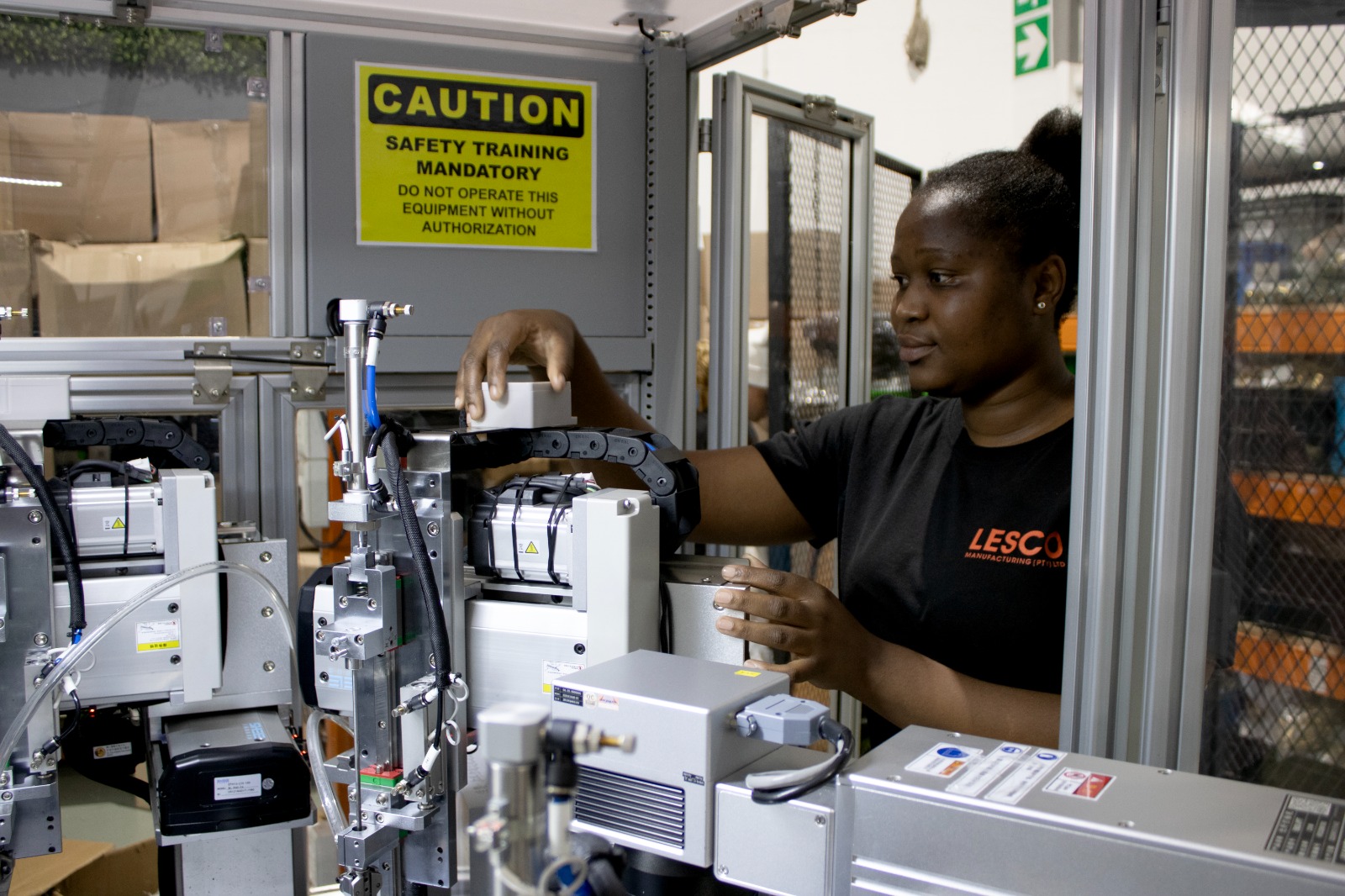
While the global narrative around Artificial Intelligence (AI) has often been defined by the fear of job losses, a third-generation South African manufacturer is proving that technology can have a soul.
Lesco, a local producer of high-quality electrical and consumer products, this week announced the launch of its state-of-the-art semi-robotic production lines, with an unprecedented twist. The technological upgrade, combined with advanced use of AI on the factory floor, will lift output by between four and ten times depending on the line, while protecting every permanent role and every position held by a differently abled employee working for the business. Lesco sources 45% of its workforce from differently abled organisations, support groups, schools and vulnerable communities across South Africa, and these positions have been ring-fenced as part of their rollout.
The company, as a leading manufacturer of switches, sockets, adapters, extension cords, and similar electrical products, currently supplies some of the largest retailers in our country, including Clicks, Build It, Builders, Makro, Buco, Mica Hardware, Cashbuild, Game, Chamberlains, and Leroy Merlin among others. They also manufacture these products for Balwin Properties. Group CEO at Lesco, Jonathan Shapiro, states that: “These are retailers that are playing a key role in ensuring that locally made products, created by an inclusive manufacturing operation, reach every South African household. They should be celebrated for sourcing their products so purposefully – by doing so, they are promoting job creation in such a critical sector of our society.”
While many industries are surrendering to the ruthless culling of jobs in the name of cold, automated efficiency, Lesco’s model is pioneering a masterclass in technology with soul, proving that we can embrace the future without sacrificing livelihoods: “Industrial innovation in South Africa should always be underpinned by an ethical commitment to inclusivity. We are proud to confirm that we are evolving with today’s technological advancements, without displacing the vulnerable workers from our country’s differently-abled community,” comments Shapiro.
The family business, which began in Shapiro’s father’s garage, currently employs over 300 people.
“We also hope that this investment into technological and AI advancements will help inspire the youth from South Africa’s differently abled community. By introducing AI and automation into the workstream, we’re sending a powerful message that disability is not a barrier to mastering the world’s most advanced technologies. For years, we’ve partnered with the Glen Oaks Academy in Kensington, and have placed their students in our work readiness programme. In 2026, those students will be exposed to local manufacturing and automation, unlike our factory has ever seen before – it’s a hugely exciting development for everyone in our circle,” adds Shapiro.
Engineered to surpass the most rigorous global standards, this world-class production line is a formidable engine of industry, aiming to double Lesco’s manufacturing capacity from 5 to 10 million units annually. With this growth, the company hopes to continue expanding its capacity through the heartbeat of the organisation: its workforce. While the World Economic Forum (WEF) predicts that automation could displace 92 million roles by 2027, Lesco is using that same tech to build a sanctuary for those often disregarded by the digital age.
“Automation doesn’t mean fewer jobs, it means different jobs,” says Shapiro. “We made a deliberate and strategic choice to implement a semi-robotic system rather than full automation. We want to show other businesses that you can innovate to be globally competitive, without sacrificing your social responsibilities”.
Lesco’s commitment to its people goes far beyond the assembly line. All supervisors are sent for sign language training in order to ensure seamless communication with all deaf employees. By June 2026, the factory will also transform into a holistic ecosystem of care by introducing an on-site occupational therapist and dedicated social worker to better support their differently abled staff. A new partnership with a major NPO will also see an additional 40 jobs created for members of SA’s differently abled community.
Lesco is also a proud member of Proudly South African, a not-for-profit advocacy campaign that was established to rally consumers, the public and private sector to intensify their support for locally manufactured goods and services, with the aim of stimulating the revitalisation of our industrial capacity, economic growth, and increasing job creation.
“The long-term sustainability of local companies hinges on their ability to remain globally competitive in a trade environment that is fiercely competitive. The attainment of this requires agility and the discretionary adoption of smart technologies that can be incorporated in the production cycle to enhance efficiencies and reduce input costs. We are delighted that Lesco managed to strike that delicate balance of incorporating cutting-edge technology in their production without sacrificing much-needed jobs that sustain so many livelihoods. The investment by Lesco provides a masterclass of the human face of technology: it demonstrates how new age technologies can be integrated in the production process to improve productivity while sustaining their human capital,” says Eustace Mashimbye, CEO of Proudly South African.
Mashimbye notes that Lesco’s choice to manufacture locally allows the company to maintain absolute control over its quality, while supporting other entities in South Africa down the value chain: “With the support of partnerships from local distributors, they keep the South African supply chain moving, while their approach to OEM (Original Equipment Manufacturing) makes Lesco products the silent force behind South Africa’s most trusted brands. As the only manufacturer in the country capable of producing these high quality and trusted products on home soil, Lesco supports the country’s economic sovereignty, it generates employment opportunities, facilitates ongoing skills development and can support work readiness programmes for our youth” Mashimbe adds.
Despite its continued commitment to remaining an inclusive employer, Lesco is also an industrial powerhouse. With SABS, ISO-9001, and SMETA accreditations, the company can confirm that it has taken a highly responsible approach to ethical audits that ensure a favourable and safe working environment at the factory.
Lesco’s story is a challenge to the global manufacturing sector: “Progress does not have to come at the cost of the vulnerable. While the future may be semi-robotic, it will also always be fully human. By balancing world-class standards with a fierce loyalty to the marginalised communities of South Africa, we hope to demonstrate that the most powerful component in any electrical product isn’t the copper or the plastic, it’s the person who made it,” concludes Shapiro.