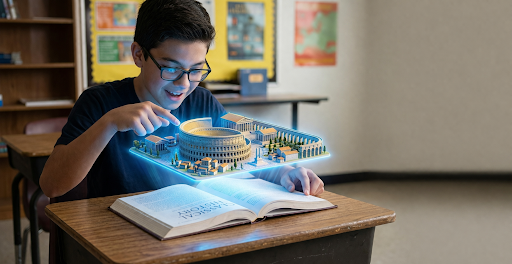
Augmented reality is no longer a futuristic concept in education. It is already used in mobile apps, classrooms, and training platforms to make learning more engaging and easier to understand. Instead of reading about complex ideas, students can now explore them directly through interactive 3D experiences.
To achieve this level of interactivity, many platforms rely on experienced education app development companies that can integrate AR features in a way that aligns with learning objectives. When implemented correctly, AR becomes more than a visual layer. It reshapes how users interact with content and how effectively they retain information.
What is augmented reality in education?
Through augmented reality, the real world can be enhanced with digital information via a device such as a smartphone or tablet, allowing users to view and interact with 3-dimensional (3D) images and animations while remaining physically present. This method is invaluable in solving one of the largest problems faced by education. Numerous subjects are very hard to teach solely by using text or still pictures. AR offers a way to convert these concepts into interactive experiences that are much easier for learners to comprehensively understand.
As an example, a student could examine a 3D image of the human body instead of trying to understand the anatomy from diagrams in a textbook. Or, students may observe chemical reactions as they occur instead of only being able to read about them in a science textbook.
Why AR is gaining traction in education
Traditional educational systems are based on students passively absorbing information (e.g., reading, watching, memorizing), but they frequently experience difficulty fully understanding what they have learned as a result. Using augmented reality (AR) enhances how students interact with the material; they can manipulate objects, navigate through virtual spaces, and see how things work in real-time, thereby allowing them to understand what they are learning at a deeper level.
Additionally, AR provides a means for students with various learning styles to engage with their educational content in different ways. For example, students who are visual learners may use 3D models to comprehend their courses, while hands-on learners may interact with various components in an educational application. Therefore, using AR to supplement traditional learning provides educators with an effective way of providing inclusive and adequate instruction to all of their students.
From a product perspective, AR creates differentiation for education technology companies from their competitors. The use of AR as a unique reference point within the Education Technology Industry provides a strong competitive advantage in a marketplace that is increasingly saturated with apps containing similar material and functionality.
Practical use cases of AR in education
Different parts of the technology have already been implemented for education purposes, with each segment addressing its own unique challenge.
Through the means of AR, one can explore science education with more complex structures – like cells, molecules, and organs – that allow for examination through rotating and manipulating multiple angles that were impossible before due to their original nature (e.g. static).
AR helps with technical skill-building through simulated processes with no actual equipment or resource provision thus creating a less costly and safer learning environment.
Language learning applications allow users find real-life objects through augmented reality and provide instant dictionary definitions or contextual information through AR as well.
AR is widely used in the school system as a learning tool to create interactive experiences to enhance student engagement with the lesson being taught while aiding in their comprehension and retention of what was learned.
In addition to creating engaging teaching materials for students, AR can help companies provide training opportunities for employees to learn in a controlled environment; consequently creating improved outcomes (i.e. fewer completed tasks) with less risk.
How AR improves learning outcomes
Augmented Reality alters the way knowledge is assimilated. Rather than learning through rote memorization, individuals learn through experience with their environment. Through AR, learners have a greater comprehension of the subject matter since they not only see it but also interact with it. They will understand how things work, rather than merely recalling factual data about them.
Additionally, because of the high level of interactivity, both visual and hands-on learning create much deeper cognitive connections that result in greater retention of the material being studied.
As mentioned earlier, Augmented Reality provides immediate feedback to learners, whereby in a classroom the educators may provide assistance, point out a mistake, or offer clarification while the learner is in the process of learning. This helps to make the process of engaging in the learning experience much more productive.
What to consider before implementing AR
AR is able to produce positive results, but you will need to put together an effective strategy first.
You should begin with your AR project by determining what The Purpose of your project will be. AR should enhance an area of the Learning Experience or address a particular Problem. If AR is used without having a set goal, it will not provide ROI.
Another important aspect of creating AR Experiences is the AR content design. AR Experiences should be designed to meet the needs of the user and facilitate alignment with Learning Objectives. If AR Interactions are poorly designed, they can cause confusion instead of providing assistance for the user.
Also, make sure the Devices AR Works On are most compatible with your users; not all Users will have the same level of device performance, and AR Applications should be optimised for a broader range of device capabilities.
In addition to device capability, the AR Application’s Performance will also play an important role in how well it meets the needs of the users. Since AR Applications require real-time data processing, any delay in processing will lead to a negative user experience.
Finally, you will need to consider how your AR Application will compile data with existing systems. Many of the AR features will need to work together with the Learning Management Systems, Analytics Tools, and other Content Platforms that are currently in use.
Implementation tips for AR education apps
A concentrated methodology is key to successfully implementing a program away from imagination and creation. At least start with one feature to test the concept for efficacy and value.
Select the appropriate technology stack that is compatible with the target platform. ARKit, ARCore, and Unity are three very popular tools with various capabilities and features.
Focus on the user experience/interface design. AR applications should provide a simple, clear, and intuitive interface for the user to interact naturally with the content being presented.
Test! Real user testing by collecting feedback on their usability will determine if there are any issues around usability so the product can be addressed before expanding.
Engage with a development team that has experience will help mitigate many of the potential risks associated with developing AR. Developing AR solutions requires knowledge of 3D modeling, in addition to mobile and backend development.
Challenges of using AR in education
While AR has many benefits, it also has some major challenges.
One challenge is the cost of development when compared to conventional applications – since 3D content must be created to a high quality but supported by high-performance applications (which require extra resources to develop).
2D and 3D models and animations can require a significant time investment to design and implement.
If the experience is not intuitive, or requires specialized hardware (e.g., motion sensors), then users may not adopt an AR app or service.
Technical limitations (such as performance issues and complex integrations) can also have an adverse effect on the final product.
By identifying and understanding these challenges, AR development teams will be able to make better plans for their projects.
Real-world perspective
Many successful augmented reality (AR) educational products are based on a focused use case rather than just creating a full-blown platform. They begin by developing one specific feature that addresses a specific obstacle.
For example, a 3D Science Application might have only interactivity (3D models) as its first feature before developing more sophisticated features like simulation or assessment. Developing one single feature at the beginning means less capital expenditure and that the new features will continue to address the needs of the users.
Using this method of building their product gradually helps validate their ideas and create products that actually deliver value to their customers.
Conclusion
The impact of augmented reality on the design and application of educational products is profound: it enhances interactivity and fosters understanding while creating a more engaging experience for learners. To successfully implement AR, there are considerations beyond just the inclusion of visual components; companies need developed strategies and quality design with technical know-how to achieve an effective implementation.
When companies apply a thoughtful approach toward AR, they will enhance the product offering and provide meaningful results to their consumer group.