Johannesburg, June 26, 2025 — AI is now woven into the fabric of daily work, with 72% of global respondents using it regularly. But the true value of AI is being captured by a smaller subset of companies that go beyond tool deployment to fully redesign workflows, according to a new report from Boston Consulting Group (BCG), AI at Work 2025: Momentum Builds, But Gaps Remain, released today.
Strong adoption, but a frontline stall—and a North/South divide
The third edition of BCG’s annual survey, based on responses from over 10,600 workers across 11 countries, including 509 from South Africa, reveals that while AI adoption is strong overall, only 51% of frontline employees globally are regular users—a figure that has stagnated.
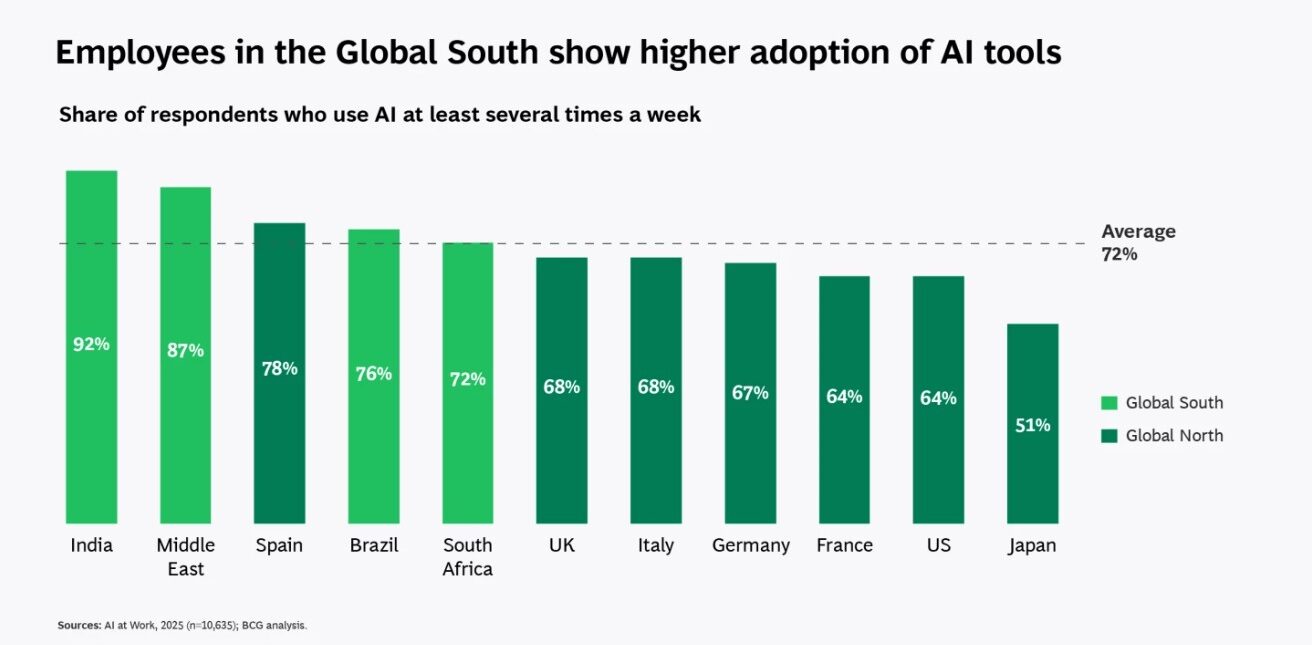
Meanwhile, the Global South continues to lead in adoption, with India at 92% and the Middle East at 87% as the nations with the highest levels of regular use. South Africa at 72% is on par with the global average of respondents who use AI at least several times a week.
The higher adoption of AI tools by employees in the Global South indicates a mentality and growth mindset spurred by countries like India that are aiming to leapfrog and capture this new industrial revolution of AI. These countries are bypassing traditional developmental stages, and in doing so, are addressing challenges in sectors like healthcare, education, and agriculture with AI.
“This strong adoption of AI is, in a sense, similar to Africa’s leapfrogging of traditional landline infrastructure by embracing mobile technology as the primary means of communication and connectivity,” said Jacqueline Foster-Mutungu, Managing Director and Partner at BCG, Johannesburg.
Furthermore, the Global South often has fewer regulatory frameworks concerning AI, allowing for quicker experimentation and deployment. This contrasts with the Global North, especially the European Union.
Yet these high-use regions also report the greatest fear about automation’s impact, with 41% of all global respondents worried their roles could disappear within the next decade.
Managers and leaders (43%) have a higher fear of job loss than frontline employees (36%) globally. The opposite is true for South African respondents; while 38% of frontline employees fear job loss – aligned to the global average, only 24% of managers and leaders fear job loss (compared to 43% globally), which is amongst the lowest worldwide.
Three key levers to boost AI adoption
- Proper training: Only 36% of global employees feel adequately trained in AI use. Those who receive five or more hours of training—especially in person and with coaching—are significantly more likely to become regular users.
- Access to the right tools: Over half of global respondents (54%) say they would use AI tools even if not authorised, with GenZ and Millennials especially prone to bypass restrictions. This “shadow AI” poses rising security risks.
- Strong leadership support: Just 25% of frontline workers globally say their leaders provide enough guidance on AI. Where leadership is engaged, adoption and employee optimism are markedly higher.
“To unlock the full potential of GenAI, business leaders must invest not only in technology, but also in comprehensive training, robust change management and unwavering leadership support—because without these foundations, the promise of AI-enabled efficiency gains will remain out of reach,” adds Foster-Mutungu.
Workflow redesign: Where real value emerges
The companies that are truly unlocking AI’s full potential are those going beyond deployment to reshape entire workflows. These organisations are:
- Investing heavily in people transformation—proper training, change management, and anticipating evolution in roles.
- Tracking the value created by AI better with tangible results
- Employees report saving more time within each work day.
- More time is spent on strategic tasks and higher-quality outputs.
- There’s greater belief that AI is improving decision making and engagement.
“Companies cannot simply roll out GenAI tools and expect transformation,” said Sylvain Duranton, Global Leader of BCG X and a co-author of the report. “Our research shows the real returns come when businesses invest in upskilling their people, redesign how work gets done, and align leadership around AI strategy.”
AI agents: The next frontier
Three in four global employees believe AI agents—smart digital assistants capable of independent task management—will be vital for future success. Yet only 13% of global employees say these tools are currently integrated into workflows, and just one-third understand how they function.
Brazil (18%), India (17%), Spain (16%), and the US (15%) are at the forefront of AI agents, while South Africa is on par with the global average with 13% of local respondents reporting that their companies are integrating AI agents into workflows.
As familiarity increases, fear fades—and workers begin to view agents as collaborators rather than competitors.
Strategic priorities for leaders
The report outlines four imperatives for organisations committed to moving from tools to transformation:
- Stop underestimating the importance of training. Commit appropriate levels of investment, time, and leadership support.
- Track the value you are generating with AI through improvements in productivity, quality, and employee satisfaction.
- Invest in your people to reshape workflows and unlock AI’s value. Anticipate AI’s impact on work, individual workers, and the workforce. Build an upskilling and reskilling capabilities to support workforce deployment.
- Experiment rigorously with agents to accelerate the experience curve. Track impact and potential risks via A/B testing.
“Companies that reshape their workflows and invest in people are seeing superior results,” said Vinciane Beauchene, Global Lead on Human x AI at BCG and a report co-author. “But that transformation must be accompanied by a clear people strategy and development engine to boost adoption and tackle the impacts it will have on work, the worker and the workforce.”