Huawei convened the Digital AI+ Government Summit, part of Huawei South Africa Connect 2026, themed “Smarter Government, Better Services”, bringing together government, healthcare and aviation leaders in Johannesburg. Together, they explored how Huawei and its partners are supporting the next leap in government digitalisation.
Michael Zhuang, Vice President of Enterprise Sales Department at Huawei Sub-Saharan Africa, delivered the opening speech at the summit. He stated, “Technology is propelling public governance beyond ‘office automation’ and ‘digital processes’ into its third phase: ‘AI-native governance.’ Huawei believes that public sector transformation must be built on trusted AI. This means three things: data localisation, end-to-end security, and deep local partnerships. Huawei will work with customers and partners to use intelligence to improve governance and technology to improve people’s lives.”
Augustine Chiew, Huawei Global Public Services BU Chief Technology Officer, stated: “AI is profoundly impacting the global economy, with many countries already proposing their national AI strategies. To systematically address the challenges posed by these strategies, Huawei has introduced the VIVA framework and fully integrated this concept into its ‘1+3+N’ architecture design. This framework uses ‘1’ trusted national large models to accelerate the intelligent transformation of ‘3’ core segments, increasing the competitiveness of ‘N’ industries. Huawei has successfully provided products and solutions in various fields, including AI + Smart City, AI + Digital Twin & Super App, AI + Physical Security, AI + Cyberspace Governance, AI + Education, and AI + Healthcare.”

Robin Chen, Vice President of Huawei’s Public Services Business Unit, pointed out that AI applications are evolving into actionable agents. Building a more efficient and fair digital government and society through cloudification and AI is the future direction. To establish new platforms, enhance new experiences, and empower the new economy, Huawei is constructing the next-generation public service architecture to create entirely new experiences. By reshaping government services with artificial intelligence, it delivers superior experiences and higher efficiency.

Magatho Mello, SITA Managing Director, stated: “SITA has been collaborating with Huawei for many years, promoting digital transformation of the public sector through integrated capabilities. SITA provides services to government in the fields of data sovereignty, innovative digital solutions, and interoperability and standards. From a transactional service provider to a strategic partner, SITA is now driving more service and innovation for its clients.”

Dr. Bello Moussa, Huawei South Africa’s Chief Solution Architect, emphasized that, emerging security threats,particularly with the rise of AI-driven fraud and sophisticated cyber-attacks, are escalating in both frequency and severity. To stay ahead, public safety must evolve from reactive models to proactive, intelligence-led ecosystems.
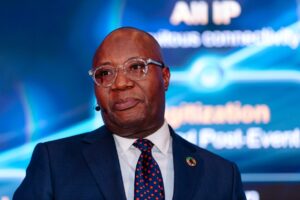
Central to this transformation, according to Dr. Moussa, is the convergence of Video+AI, which enables real-time visual insights powered by machine learning, and an AI Command Center that serves as the central nervous system for threat detection, decision-making, and coordinated response. However, he emphasized that for these capabilities to function effectively, data fusion is essential, integrating siloed information from sensors, cameras, networks, and databases into a unified, actionable intelligence layer.
To achieve this, Huawei, proposes the “One Network, One Cloud, One Platform, and N Scenarios” architecture, a holistic framework designed to propel public safety into the AI era. This structure, he noted, not only unifies infrastructure but also embeds AI at every layer, ensuring that data-driven foresight, rather than hindsight, becomes the new standard for protecting communities.
Jay Zhang, Vice President of Runda Healthcare, stated: “The time resources of doctors are a global healthcare challenge. Medical AI infrastructure is a scalable pathway to distributing expert capabilities. Runda, in collaboration with Huawei, provides a unified national architecture that consolidates data, compute and models, then scales trusted AI across hospitals.”

Justin Liu, Director of Huawei’s Intelligent Campus Marketing and Solution Sales Department, released the AI Campus Report globally. He stated: “AI has entered the physical world, driving intelligent spaces to become the core of AI campuses. Huawei is working with partners to accelerate AI campus construction. Huawei is consolidating the foundation of AI campuses through connectivity, data, and intelligence.” By integrating connectivity, sensing, and security, Huawei is building a neural network and immune system for AI campuses. Additionally, Huawei is creating 10 smart spaces, such as Intelligent Conference Room Space and Intelligent Ward Space, to reshape the service model and experience for AI campuses.”

In the future, Huawei will continue to deepen its presence in South Africa. Working hand in hand with customers and partners, Huawei will explore innovative technologies, embrace opportunities and challenges together, and create a new era of smarter government.