
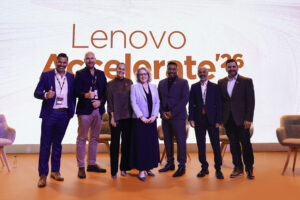
Lenovo has concluded its annual regional summit, Lenovo Accelerate 2026 Southern Africa, outlining the strategic roadmap for enterprise Artificial Intelligence (AI) deployment across the continent. Addressing an audience of regional CIOs, enterprise decision-makers, and technology partners, the company framed the current market as a transition phase where organisations must pivot from AI experimentation to quantifiable execution and ROI.
The summit coincided with continued strong global momentum for Lenovo. The company reported significant growth in its AI-driven business, with AI-related revenue increasing 84% year-on-year and accounting for 38% of total group revenue in the fourth quarter, highlighting the accelerating demand for AI-enabled infrastructure, devices, and services.
The business also reported encouraging progress following the relaunch of the Motorola smartphone brand in South Africa last year, while continuing to strengthen its position across key technology segments in the region. This momentum was reflected in strong double-digit year-on-year growth across key business units.
“These financial milestones reflect a systemic shift in how African enterprises are prioritising technology investments,” said Yugen Naidoo, General Manager of Lenovo Southern Africa, during his opening address on The Sovereign Tech Blueprint. “Our growth in infrastructure and services across Southern Africa indicates that organisations are actively laying the physical and operational foundations required to operationalise AI. This transition is built entirely on localised collaboration and deep ecosystem trust.”
High Demand, High Friction: The CIO Dilemma in 2026
As Southern African enterprises expand their digital operations, technology leaders are under growing pressure to deliver tangible business outcomes from their technology investments. Discussions at the summit highlighted increasing confidence in AI’s ability to generate measurable returns, while emphasising the importance of moving beyond experimentation toward practical, scalable deployment.
Organisations across the region are therefore expected to continue increasing investment in AI initiatives over the coming year, with infrastructure remaining a central priority as businesses build the foundation needed to support AI-driven transformation. However, the path to enterprise-scale AI adoption remains constrained by several systemic and regional operational challenges:
Memory and Compute Limitations: The growing computational demands of large language models are increasing infrastructure complexity and overall operating costs.
Latency Challenges: Network delays can impact the performance of real-time, cloud-dependent applications, limiting their effectiveness in time-sensitive environments.
Data Sovereignty and Compliance: Evolving regulatory requirements and rising cybersecurity concerns have made robust governance and compliance frameworks essential for AI deployment.
Energy Constraints: Ongoing power and energy challenges across Southern Africa continue to pose risks to the scalability of AI infrastructure and broader sustainability objectives.
Why Workloads Are Moving to the Edge
To address these infrastructure and security constraints, Lenovo highlighted its Hybrid AI architecture. Instead of relying only on public cloud systems, which can create latency, cost, and compliance challenges, the hybrid approach spreads AI workloads across devices, private enterprise environments, and public cloud platforms.
This shift reflects a broader industry trend toward combining on-device, on-premise, and cloud-based AI to improve performance, maintain data control, and ensure operational resilience.
“Successful enterprise transformation is intrinsically outcome-driven,” said Chadie Ghadie, CTO and ISG Leader for Lenovo MEA, during a technical session on hybrid systems. “To move AI from the cloud to the edge, we must solve real-world physical constraints. This requires matching localised data processing with infrastructure optimised for efficiency and security.”
Lenovo detailed several enterprise-grade systems engineered to address these localised requirements:
The Lenovo ThinkEdge SE455i V3: Designed for localised, low-latency inferencing directly at the data source.
The Lenovo ThinkSystem SR650i V4: Engineered for high-density, cost-effective datacentre inferencing.
Neptune™ Liquid Cooling: Reduces datacentre power consumption by addressing the critical intersection of high-compute demands and regional energy deficits.
Ecosystem Collaboration as a Market Differentiator
The summit concluded with a panel discussion featuring Fiona O’Brien, VP of Sales Transformation & Enablement for Lenovo Europe and META, and Andrea Talmacsi, Marketing Director for Lenovo META. The panel emphasised that the complexity of modern technology stacks requires a shift away from single-vendor isolation toward deep ecosystem partnerships.
“Whether accelerating Device-as-a-Service (DaaS) models, securing distributed endpoints, or deploying localised AI models, no single entity can drive transformation in isolation,” O’Brien stated. “Ecosystem collaboration is the true differentiator in unlocking scalable, low-risk innovation.”
Highlighting its global engineering scale, Lenovo also discussed its strategic partnership with FIFA, where it will serve as the official technology partner to power the first AI-driven tournament at the upcoming World Cup, enhancing real-time analytics, stadium operations, and fan experiences on a global scale.
With an established global footprint, localised double-digit growth, and a hardware-software pipeline tailored to the resource constraints of the African continent, Lenovo enters the second half of 2026 positioned to transition regional enterprises from AI pilots to scaled production.