Anyone who has bought enterprise software knows the ritual. There is a comparison grid with four columns, a set of ticks and crosses, and a feature you actually need sitting one column to the right of the one you can afford. Weeks disappear into working out which version to buy, before anyone has discussed what the software is meant to do.
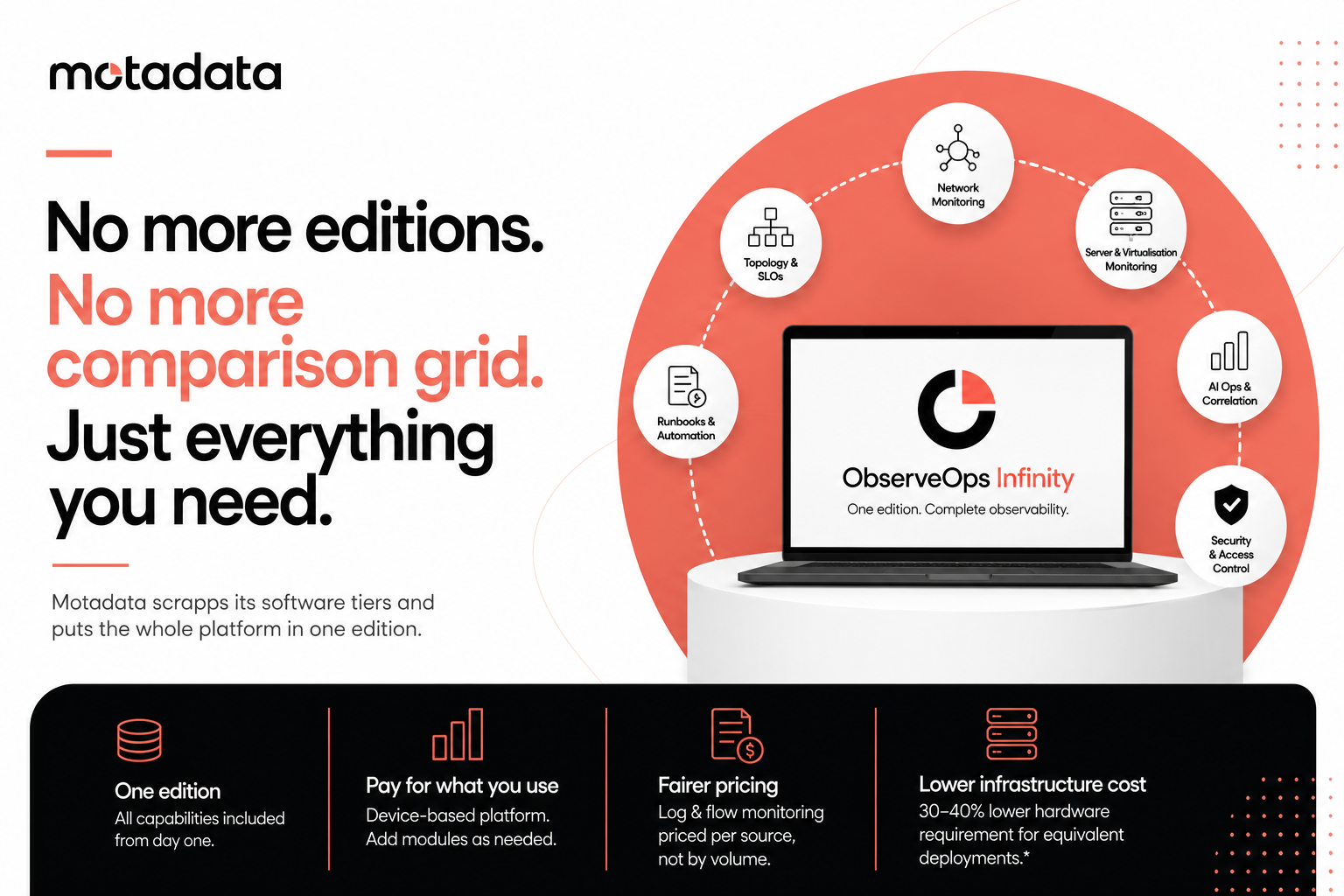
Motadata has removed that step from its observability product. ObserveOps Infinity, generally available since August 2026, replaces the four editions the company previously sold with a single one.
One Edition, No Grid
The complete platform now arrives from day one. That includes monitoring across networks, servers and virtualisation, topology mapping, service level objectives, dashboards, AIOps, event correlation, runbook automation, integrations, a new observability pipeline and security controls covering single sign-on, multi-factor authentication and role-based access control.
There is nothing sitting behind a higher plan, because there is no higher plan.
What a customer pays for is what they choose to watch. The base is counted by the number of monitored devices. Optional modules for flow monitoring, log monitoring, network configuration management, application performance monitoring and real user monitoring can be added in any combination, each counted by its own unit. Adding devices or switching on a module is a quantity change rather than a product change.
Motadata has also changed how log and flow monitoring are charged. These used to be priced by the gigabyte per day. They are now priced per source, which means an organisation is billed for how many things it watches rather than how much data those things produce. If an application starts generating far more log data than it did last month, the bill stays where it was.
Customers still running one of the four withdrawn editions are not being pushed to move. Existing contracts continue as they are.
Why the Hardware Bill Came Down
The change most likely to show up in a budget has nothing to do with licensing.
Observability software is demanding on infrastructure. It works hard when data arrives and it consumes storage once that data is at rest. As server, memory and storage prices have risen worldwide, that cost has landed on customers, usually as an increase passed through by the vendor.
Motadata took the opposite approach and treated the hardware requirement as something to engineer down. The company reworked how data is ingested, how it is stored, how it is rolled up and indexed, and how efficiently its collectors run. It reports an indicative reduction of 30 to 40 percent in the hardware needed for an equivalent deployment.
The company is upfront that this is a range rather than a promise. The actual figure depends on the mix of devices, how long data is kept, how often things are polled, which modules are in use and how the deployment is laid out, and every deployment is sized properly before a quote is issued.
For an IT team, fewer servers means less to run, less to patch and less to keep resilient. It also makes high availability affordable for organisations that had shelved the idea because duplicating an expensive setup was out of reach.
Deciding What Is Worth Keeping
A large part of that reduction comes from a new piece of the platform. ObserveOps Infinity adds an observability pipeline that sits between where data comes from and where it ends up.
It turns logs, events, traps, flows and metrics into structured, searchable fields as they arrive rather than storing them as raw text. It filters, reduces and masks sensitive information before any of it is written down. It attaches useful context to every event, such as which system it belongs to, which site it is at, who owns it and which business service it supports, so an engineer responding at two in the morning is not assembling that picture by hand. It lets an organisation decide by policy how long different kinds of data are kept. And it copes with sudden surges without dropping data at exactly the moment that data matters most.
The point is simple enough. Data you never store costs nothing to store. The pipeline is included in the base platform at no extra charge.
The AI Part, Stated Carefully
Motadata says the release prepares its platform for agentic AI, meaning software that investigates and resolves issues with limited human involvement. It has been careful not to claim more than that.
What exists today is the groundwork: structured and enriched data, governed retention and masking, correlation and anomaly detection, and automated runbooks with an approval step before anything is actioned. What does not exist yet is the autonomous layer on top, and the company has not put a date on it.
Its commitment is that when those capabilities do arrive, they will arrive on the same platform and the same licence, with no need to move product again.
ObserveOps Infinity is generally available from August 2026.