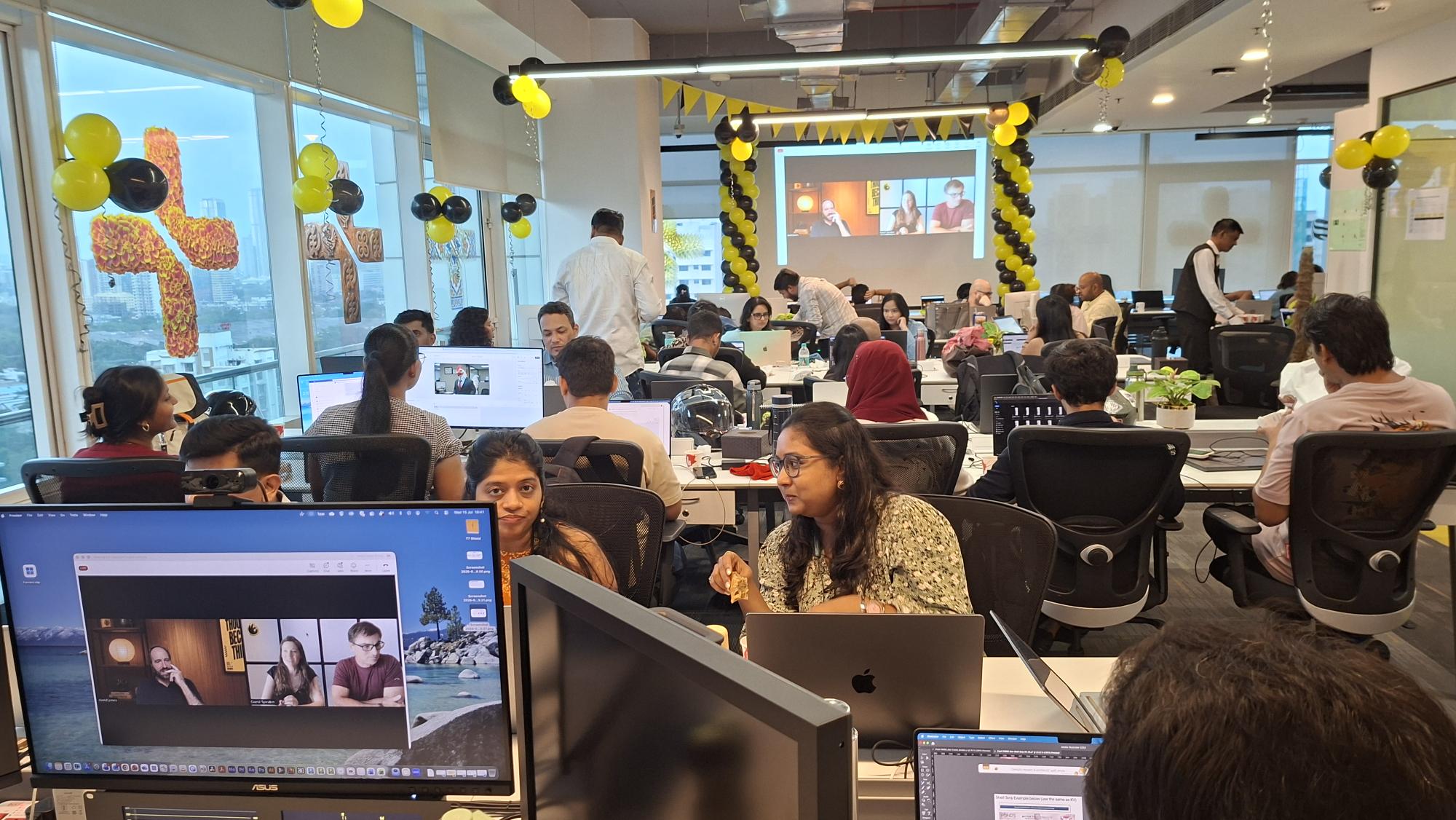
The global AI Culture Week initiative offers a different approach to closing the AI skills gap by giving people the time and permission to learn by doing.
As businesses grapple with how to turn investment in generative AI into real workforce capability, Brandtech Group took a different approach and stopped meetings company-wide for a week to give its people time to learn.
As part of The Brandtech Group’s first global AI Culture Week, 4,630 employees across more than 30 countries and 14 businesses, including Brandtech+, were encouraged to step away from their usual meeting schedules and use dedicated working time to learn, test, build and explore how AI could change the way they work.
Collectively, employees spent around 20,000 hours participating, attended an average of eight sessions each, asked more than 1,200 questions and submitted 1,600 pieces of feedback.
“The initiative reflects a growing challenge facing the creative and marketing industries: The world may be adopting AI faster than people have the time or opportunity to develop the skills to use it effectively,” says Gabrielle Gray, Global Head of Capabilities at Brandtech+. “You can’t tell people to become AI-ready and then give them no time to learn. Our clients all understood how important this was, so while work didn’t stop, they did allow our teams to immerse themselves fully.”
“The skills gap isn’t going to be solved by giving employees access to another tool and expecting adoption to happen automatically,” she explains. “If we want people to work differently, learning and experimentation must become part of the work itself, and we need to ensure that people remain at the helm.”
She notes that it is also as much about learning as it is about educating on responsible AI usage, particularly at a time when AI adoption and oversight is such a globally relevant topic.
“Implementing AI Culture Week at the Brandtech Group level allowed us to move from AI training to AI culture, and the distinction was deliberate,” she adds. “Recognising that embedding AI into everyday work requires more than just training.”
Employees took part in practical challenges, role-specific sessions, vibe coding and discussions around responsible AI, ethics and the future of work. With sessions covering creative, strategy, social, sales, operations, data, and client leadership, with an emphasis on applying AI to real workflows rather than learning technology in isolation.
“One of the clearest examples came from a vibe-coding challenge: what began as an idea shared on Slack ended with five functioning applications built by people who don’t consider themselves engineers,” Gray says. “This included an AI transformation dashboard for client projects and a hub connecting employee resource groups.”
“The distance between having an idea and launching it is shrinking every day. You don’t necessarily need a technical background to start building with AI,” she says. “For creative talent, that changes the skills equation. Curiosity, experimentation and the confidence to try something are becoming increasingly valuable.”
Gray notes that the AI skills gap can’t simply be recruited away. “For agencies, this creates another challenge, because the AI skills shortage cannot simply be solved through recruitment.”
“Generative AI is evolving too quickly for businesses to rely on an established external talent pool,” Gray explains. “Brandtech+’s approach is therefore focused on building capability internally, with AI Culture Week reinforcing the Group’s emphasis on upskilling existing employees and encouraging learning across disciplines and businesses.”
“There isn’t a generation of people with ten years of generative AI experience waiting to be hired,” she says. “Businesses have to grow this capability themselves, which means nurturing emerging talent, but it also means continuously reskilling experienced people as their roles evolve.”
“Throughout AI Culture Week, employees were encouraged to think critically about what should be delegated to AI and what should remain distinctly human,” explains Gray.
“Judgement, craft, taste, cultural understanding, empathy and storytelling emerged repeatedly as capabilities likely to become more valuable as AI makes execution faster and more accessible.”
“Being AI-ready doesn’t mean being AI-only,” she says. “AI should give people more space for the thinking, judgement and creativity that make great work distinctive, otherwise, we risk becoming faster without necessarily becoming better.”
The Brandtech+ global initiative suggests that building an AI-first workforce may start with giving people the time, space, and permission to learn how to use it in a way that makes them comfortable and empowered.