The rules of cybersecurity are changing as AI-powered attackers operate at machine speed, increasing the scale, complexity, and efficiency of cyber threats. To keep pace, organisations require a new cyber stack that can continuously perceive risk, reason across vast amounts of context, and take action at the pace of modern threats, while empowering defenders with better insights and more powerful ways to act.
That is why Microsoft has built Project Perception, a new agentic security system designed for the realities of AI. It helps security teams shift from reactive, human-led workflows to coordinated, AI-driven protection at the speed required by today’s evolving cyber landscape.
Across Africa, AI-powered threats are eroding the barriers that once protected smaller organisations from cyberattacks. As attackers use AI to automate reconnaissance, identify vulnerabilities and scale campaigns at unprecedented speed and lower cost, organisations of all sizes are becoming viable targets.
“Historically, attackers focused their efforts on larger economies and high-value targets, but AI is changing the economics of cybercrime,” says Kerissa Varma, Microsoft’s Chief Security Advisor for Africa. “The cost of launching attacks is falling while their reach is expanding, enabling threat actors to target more organisations simultaneously. As a result, businesses across Africa, including those that may previously have fallen below an attacker’s radar, need security capabilities that can detect, analyse and respond to threats around the clock.”
This shift is particularly significant for organisations that have historically operated with limited security resources or less mature security controls.
A cyber stack built for agentic security

“Security is an always-on mission, and organisations need protection that is not only highly effective, but also continuously available and cost-effective at scale. Delivering this requires more than access to a single advanced AI model – it means applying the right model to the right task,” adds Varma.
Project Perception, designed from the ground up, brings together signals, context, models, and specialised agents into a continuously learning system of defence. It can reason, prioritise, and act at the speed of AI while keeping security teams firmly in control and empowering them with powerful new workflows.
With its multi-model architecture, Project Perception combines frontier and specialised cybersecurity models to optimise both quality and cost, helping organisations stay ahead of evolving threats while maximising value.
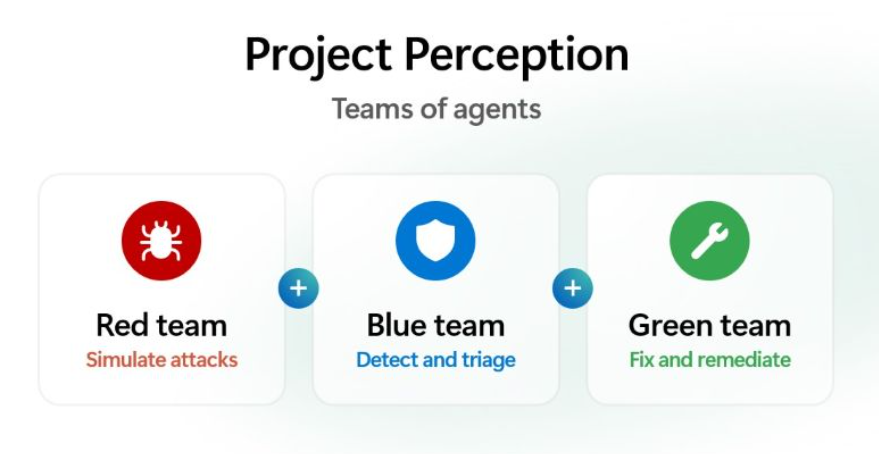
Effective defence requires continuously understanding how an attacker sees the world, how a defender evaluates risk, and how protections are improved over time. To accomplish this, Project Perception coordinates three classes of specialised agents. Red team agents identify potential paths to compromise before an attacker can exploit them. Blue team agents investigate, reason over context, and determine what represents meaningful risk. Green team agents take corrective actions and strengthen defences across the environment. Working together, these agents form a closed-loop system that continuously discovers, evaluates, and improves an organisation’s security posture.
As Africa’s most targeted cybercrime market, South Africa is already experiencing the growing impact of increasingly sophisticated attacks. At the same time, many organisations continue to face cybersecurity skills shortages and resource constraints, with the CSIR’s 2024 national cybersecurity survey finding that 63% of cybersecurity roles in South Africa are partially or fully unfilled. This challenge is particularly acute outside traditional business hours, when security teams often operate with reduced capacity.
“The introduction of the first Red/Blue/Green multi-agent autonomous workflow in Microsoft Defender marks an important step forward, enabling organisations to triage alerts, investigate incidents, map attack paths and prioritise remediation across the security stack,” says Varma.
By combining autonomous agents that can continuously investigate, defend and prioritise action, organisations can strengthen their security posture around the clock while benefiting from a more cost-effective approach that helps address both skills and resource challenges.
However, technology alone is not enough. Organisations must also continuously upskill their workforce and embed security into everyday operations and performance measures, because culture, readiness and people remain critical to building cyber resilience.
Security context built for AI
Against this backdrop, organisations need security capabilities that not only augment human expertise but are also informed by comprehensive visibility and deep security intelligence.
Microsoft brings together visibility across identities, endpoints, applications, data, clouds, and AI systems. Combined with decades of security research, threat intelligence, and real-world operational experience, these capabilities shape how Project Perception reasons, prioritises, and responds.
As part of its multi-model strategy, Microsoft is committed to delivering the best models for each security task, while continuing to innovate with its own specialised models. The first application of this approach is software vulnerability management, with the integration of MAI-Cyber-1-Flash inside MDASH, Microsoft’s software vulnerability multi-model team of agents.
MDASH with MAI-Cyber-1-Flash delivers 96% on CyberGym, an industry leading benchmark, +12 points above Mythos. And this same configuration delivers almost 50% of cost savings when compared to the current MDASH configuration in market today.
Next, Project Perception will take advantage of MAI-Cyber-1-Flash for many more security workflows, beyond the software vulnerability scenario.
Project Perception is built in alignment with Microsoft’s Responsible AI principles and inherits the security, compliance, governance, and operational controls its customers already rely on. This ensures these capabilities are delivered with the same rigor, accountability, and enterprise readiness that customers expect.
“By delivering integrated, multi-model AI with agentic security capabilities, Microsoft is helping shape the next era of cybersecurity, delivering intelligent, autonomous and cost-effective defence built for the speed, scale and complexity of AI-powered threats,” concludes Varma.
Project Perception enters public preview on 3 August 2026.